A car fine can display several dates at once: the day of the alleged violation, the date the notice was issued or published, the delivery date, the end of a discount window, and the final payment deadline. The most common mistake is to start counting from the first date that appears. A safer method begins by identifying the issuing authority, how the notice was legally delivered, and which deadline the official record currently shows.
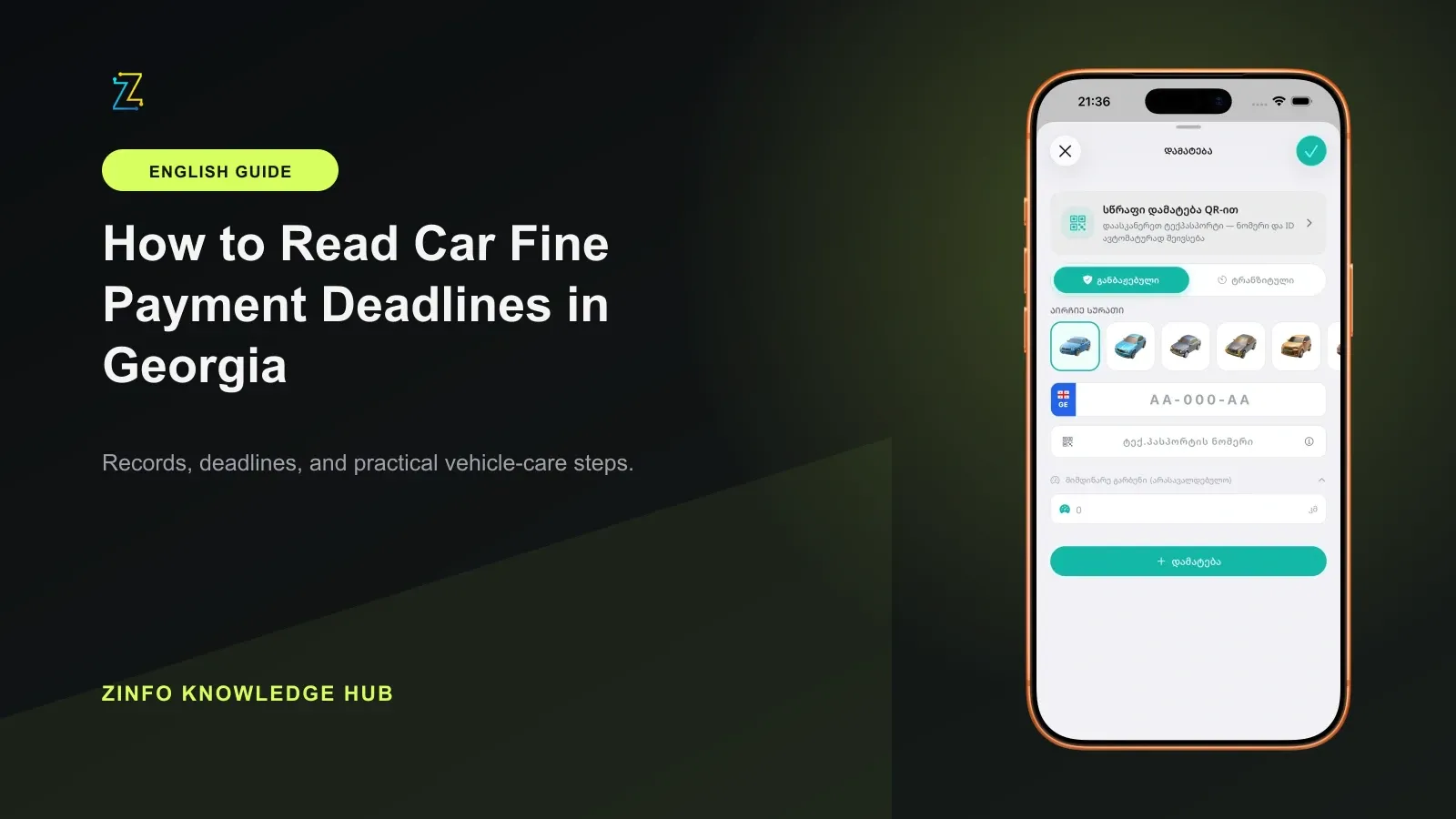
The cars, fines, and maintenance area in ZINFO can organize available amounts, deadlines, discount or late-fee information, issuing authorities, legal details, and media around a vehicle record. It helps you read the notice systematically, but the relevant authority remains the source of record for the final legal status and amount due.
1. Identify the fine type and issuing authority first
There is no single shortcut that applies identically to every patrol, camera, parking, or other vehicle fine. Find the issuing authority, the notice or decision number, the legal basis, and the vehicle registration plate. These fields determine where the record should be checked and which deadline rules may apply.
The consolidated Georgian Code of Administrative Offences in force when checked on October 5, 2026 uses a general rule of payment within 30 days after delivery of the decision or fine receipt. The same provision contains specific exceptions. Treat 30 days as an important general reference, not as permission to ignore a shorter or special deadline printed on the exact record.
For a record administered by the police, confirm it through the Ministry of Internal Affairs administrative offences system. For a municipal parking fine or a notice issued by another authority, use the official channel named on that record.
2. Separate the four dates that matter
In the fine details and media view, write down these dates separately:
- The violation date, when the alleged event occurred.
- The date the notice or decision was issued.
- The date it was delivered or legally treated as delivered.
- The final payment date shown by the official record.
The violation date is often not the date when the payment clock begins. The general 30-day rule is tied to delivery. A notice issued at the roadside, a camera record, postal delivery, electronic notification, and public publication can involve different practical steps.
If ZINFO and the official source show different dates, make the payment or appeal decision from the official record. First confirm that both views refer to the same notice number, vehicle, and issuing authority.
3. Find the legally relevant delivery event
The key question is often: when was the notice legally delivered? For a receipt handed over at the roadside, delivery is connected with that receipt. For an MIA record handled remotely, information may be sent by text message or another technical method while a copy is made available through the ministry's official website.
If postal delivery cannot be completed or sending is impossible, the relevant code provision uses official web publication. The MIA published fine receipts page explains that in this situation a fine receipt is treated as delivered on the 30th day after public publication.
That 30-day period is not itself the payment deadline. It identifies the delivery event from which the applicable payment period may begin. Record the publication date, the date on which delivery is legally deemed to occur, and the final payment date as three separate entries.
4. Do not confuse a discount window with the final deadline
Some records can have a short discount window and a longer final payment period. The current code provides a 20 percent reduction for certain MIA notices paid within 10 calendar days after information is received through the specified notification pathway, with exceptions. For a municipal record, check the specific issuing authority and governing provision before applying any discount.
Ask three separate questions:
- When does the discount window start?
- What amount applies during that window?
- When does the full payment period end?
Missing the discount date does not automatically mean the full payment deadline has also passed. However, do not send the old discounted amount after that window expires. Refresh the official record and use the current amount displayed there.
5. Distinguish calendar days from working days
Article 290(6) moves the last day of the payment period specified in Article 290(1) to the next working day when it falls on a Saturday, Sunday, or statutory public holiday. This provision refers to that payment period. Do not assume it also extends the separate 10-calendar-day discount window in Article 268¹.
Do not transfer that rule to every notice without checking its legal basis and exact wording. If the apparent final day is a holiday but the official system displays another date, ask the issuing authority to confirm it before payment. Checking several hours or days early is safer than relying on a last-minute interpretation.
Matsne can display the text currently in force together with amendments scheduled to take effect later. Use the version effective on the day of your check, not future wording shown in brackets.
6. Keep an appeal and a payment as separate processes
The general rule also addresses suspension of the payment period when a decision is appealed or protested, but the outcome for a specific case depends on the fine type, the resulting decision, and delivery of that decision. A screenshot showing that an appeal form was submitted is not enough by itself.
Article 290, paragraph 1⁵ provides that appealing fine decisions in cases covered by Articles 208 and 208² does not suspend the payment period in Article 290(1). Filing an appeal therefore does not by itself establish that your payment deadline has stopped.
Save proof that the appeal was received, the case reference, and the delivery date of the decision. Then confirm the revised deadline and amount with the authority. If the decision no longer qualifies for a discount, paying the earlier reduced amount may leave a balance outstanding.
This guide is not legal advice. If delivery is disputed, the notice identifies another person, or you are considering an appeal, contact the issuing authority or a qualified Georgian lawyer promptly.
7. Handle a missed deadline without guessing
An unpaid fine can lead to loss of a discount, a late fee, and later enforcement steps. The exact consequence depends on the offence category and legal basis. After a deadline has passed, do not pay an amount copied from an old message.
Open the current official record and compare:
- The original fine
- Any late fee that has been added
- The current total amount due
- Any new payment or enforcement date
- The notice number and receiving authority
After paying, save the transaction receipt and unique reference. If the status does not update immediately, do not automatically repeat the payment. Confirm the banking result first, then ask the issuing authority whether the payment has been applied.
8. Use reminders, but keep your own deadline record
If fine reminders are available for your account, use them as an additional signal for a newly found fine or an approaching deadline. A reminder does not replace legal delivery, the text of the notice, or the authority's official record.
Keep a compact record containing the notice number, issuer, delivery date, discount date, final payment date, and current amount. When using fine payment and history, add the payment receipt to that record.
If you first need to locate and verify the correct fine, follow the complete guide to checking car fines in Georgia. Build the deadline record only after the correct vehicle and notice have been matched.
Keep the legal provision beside the date
During the October 5, 2026 review, the MIA notification and discount pathway was checked against Article 268¹, while the general payment period and its last-day rule were checked against Article 290 of the Code of Administrative Offences. These are different steps in the process. A discount message is not enough to identify the final deadline for every type of fine.
Add the relevant article number to your deadline note, together with the issuer, receipt number, source address, and time of your check. If the official record gives a special rule, keep that wording with the record instead of replacing it with a general calculation. This makes a later question to the issuing authority concrete: which delivery event and which provision produced the displayed deadline?
Final checklist
- I identified the issuing authority and the exact notice number
- I separated the violation, issue, publication, delivery, and payment dates
- I calculated from the legally relevant delivery event
- I did not confuse the discount window with the final payment period
- I applied calendar-day and working-day rules only after checking the governing provision
- I confirmed the current amount and final date in the official system
- I saved proof of receipt and the resulting decision if I filed an appeal
- I saved the payment receipt and checked the status again
- I did not treat a reminder as a substitute for the official record
The method is simple: identify the controlling official record, find the legally relevant delivery date, and only then calculate discount and payment periods. Return to the ZINFO knowledge hub for more practical guides about vehicles and everyday services in Georgia.
Sources
- Cars, fines, and maintenance · ZINFO · 2026-10-05
- საქართველოს ადმინისტრაციულ სამართალდარღვევათა კოდექსი · სსიპ საქართველოს საკანონმდებლო მაცნე · 2026-10-05
- ადმინისტრაციული სამართალდარღვევები · საქართველოს შინაგან საქმეთა სამინისტრო · 2026-10-05
- გამოქვეყნებული საჯარიმო ქვითრები · საქართველოს შინაგან საქმეთა სამინისტროს საჯარო ინფორმაციის ვებგვერდი · 2026-10-05