Estimating fuel cost for a trip requires three main inputs: the complete distance, the vehicle's realistic fuel consumption in liters per 100 kilometers, and the price per liter for the exact fuel you plan to buy. The arithmetic is simple, but an estimate is only useful when the route is complete and the consumption figure reflects how the vehicle is actually used.
The ZINFO fuel calculator brings those inputs together. Choose a station and fuel, enter average consumption and distance, and review the estimated liters and cost. This guide explains how to prepare the inputs, compare alternatives, and use the result as a planning figure rather than a guaranteed bill.
1. Start with the complete trip distance
A one-way distance between two cities is rarely the whole journey. Include the drive from your starting address, the return leg, local movement at the destination, and any known detours. If you need to collect a passenger, visit several addresses, or leave the main road for a planned stop, those kilometers belong in the estimate.
A practical distance list includes:
- The main route in one direction
- The return route
- Local driving at the destination
- Known stops, pickups, and detours
Check the navigation distance shortly before departure. A route can change because of restrictions, congestion, construction, or a different stop. When two routes are possible, estimate each one separately. The shorter option may not always use less fuel if it has heavier traffic, steeper grades, or long periods of slow movement.
2. Use realistic fuel consumption
The published figure for a vehicle is a useful starting point, but a recent real average is often better for planning a particular trip. City traffic, highway speed, hills, vehicle load, tires, air conditioning, temperature, and driving style can change consumption. No single number will describe every route and season perfectly.
If you track consumption yourself, use a consistent method. After filling the tank, record the distance driven and the liters added at the next comparable fill. The basic calculation is:
Average liters per 100 km = liters added ÷ kilometers driven × 100
For example, adding 40 liters after driving 500 kilometers gives an average of 8 liters per 100 kilometers. That result describes the previous period. If the next trip has different traffic, weather, road grade, passengers, or luggage, account for that uncertainty separately instead of pretending the historical average is exact.
3. Calculate liters and estimated cost
Once the complete distance and average consumption are ready, calculate the fuel needed:
Liters needed = total distance × liters per 100 km ÷ 100
Then calculate the estimated fuel cost:
Estimated cost = liters needed × price per liter
In a purely illustrative example, a 300-kilometer trip at 8 liters per 100 kilometers requires 24 liters. If the matching fuel were priced at an illustrative 3.00 GEL per liter, the starting estimate would be 72 GEL. That price is not presented as a current market quote. It exists only to show how the formula works.
If several travelers will split the fuel cost, calculate the whole trip first and then divide it using the rule the group agrees on. Keep parking, tolls, food, accommodation, and other travel expenses outside the fuel calculation so each part of the budget remains clear.
4. Use the ZINFO calculator consistently
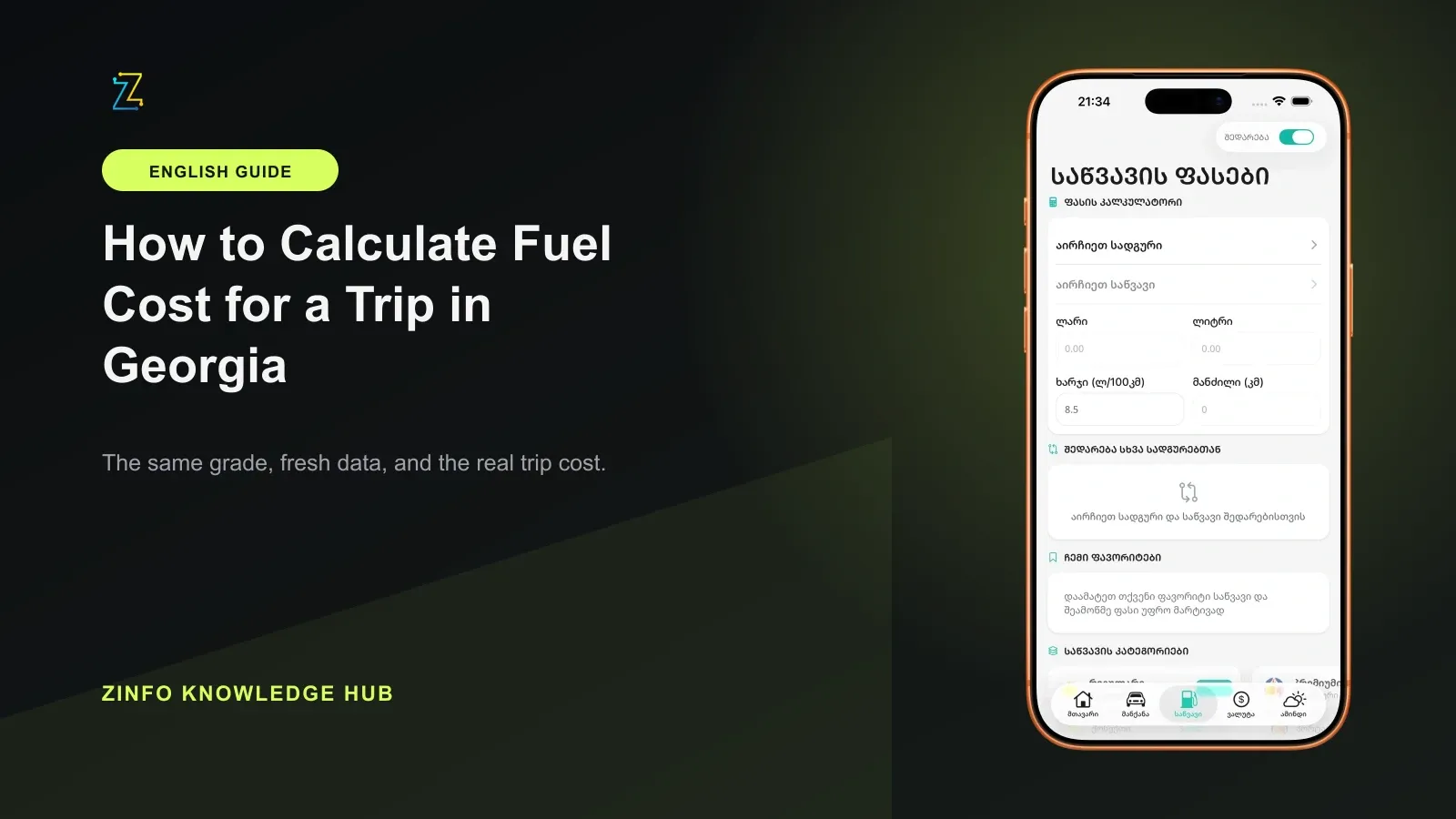
On the fuel and stations feature page, choose the network and the exact fuel that matches the vehicle. Enter the realistic average consumption and the complete trip distance. The calculator then shows the estimated quantity and cost using the selected price.
A reliable workflow is:
- Confirm the fuel type and unit.
- Choose the relevant station or fuel product.
- Enter average consumption per 100 kilometers.
- Enter the complete trip distance.
- Record the resulting liters and estimated cost.
To compare another station, keep the distance and consumption assumptions unchanged and compare the matching fuel price. This isolates the price difference instead of mixing several variables at once. The separate guide to comparing fuel prices in Georgia explains how to match fuel grade, update time, and station location before making that comparison.
5. Compare more than one scenario
One result can create false confidence. Two or three scenarios are usually more useful. You might compare the normal route with a longer alternative, or compare the vehicle's recent average consumption with a more cautious planning figure. Change one input at a time so you can see what caused the difference.
A small planning table can contain four columns: route, kilometers, liters per 100 kilometers, and fuel price. The resulting liters and cost make it easier to see whether the important factor is an extra detour, heavier consumption, or a different station price.
The ZINFO fuel price area helps you find matching options among supported fuel products. Confirm the final price at the chosen station because displayed prices can change or differ by location. Do not treat an older or mismatched price as precise enough for the final budget.
6. Understand the limits of the estimate
A calculator can apply the formula consistently, but it cannot predict every event on the road. Congestion, extended idling, strong wind, cold or hot weather, steep climbs, added load, tire condition, and an unexpected detour can change real fuel use. Official fuel-consumption ratings are useful for comparison, yet official guidance also notes that laboratory ratings cannot reproduce every condition drivers encounter.
Treat the result as a planning estimate. Add a separate contingency that fits the route and your tolerance for uncertainty, especially when stations are far apart, the route is unfamiliar, or conditions may change. A contingency does not mean the formula is wrong. It covers the difference between clean inputs and a trip that unfolds in the real world.
For a return journey on the same road, do not assume both directions will consume exactly the same amount. Elevation, traffic, wind, and local driving may differ. The combined round-trip estimate is still useful, but the final dashboard reading and the next fill are better evidence of what the vehicle actually used.
7. Final checklist before departure
Review these points before relying on the number:
- The route includes the return leg and known detours
- Consumption reflects the vehicle's real use or a clearly chosen planning assumption
- The correct fuel type has been selected
- The price is current enough and matches the chosen product
- Liters and cost were calculated from the same distance and consumption inputs
- A separate contingency covers changing route and driving conditions
- Non-fuel travel expenses are listed separately
This method creates a repeatable estimate that is easier to review and compare. For more practical guidance, return to the ZINFO knowledge hub and prepare the other checks that matter before a trip in Georgia.
Sources
- Fuel and stations · ZINFO · 2026-08-18
- Understanding fuel consumption ratings · Natural Resources Canada · 2026-08-18
- 2026 Fuel Consumption Guide · Natural Resources Canada · 2026-08-18