A used-car listing can look convincing while leaving major questions about the vehicle's identity and past unanswered. Photos, price, and a seller's description are useful starting points, but they do not prove that every document and record belongs to the same car. The vehicle identification number, or VIN, gives you a consistent key for comparing those sources.
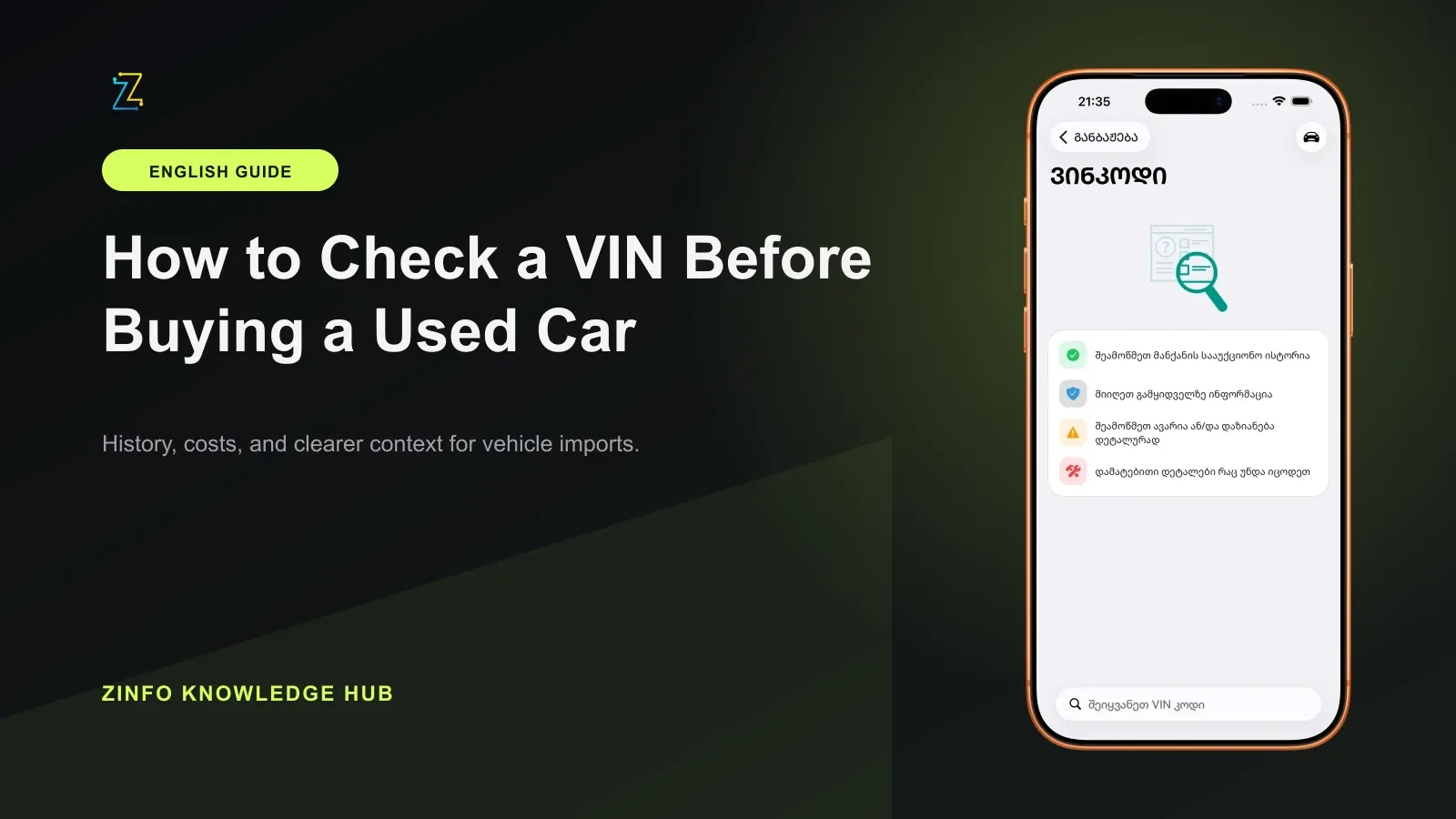
The vehicle research and imports area in ZINFO lets you enter a 17-character VIN and review available vehicle details and history. The useful result is not a simple green or red answer. It is a structured set of facts that you compare with the listing, documents, official records, and the physical vehicle before you commit money.
1. Get the complete VIN before evaluating the car
Ask the seller for a clear close-up of the VIN as it appears on the vehicle. NHTSA notes that a 17-character VIN can commonly be found at the lower left of the windshield and on the registration card. For an imported car, also request the relevant sections of the title or registration document, auction record, purchase invoice, shipping document, and any listing that identifies the vehicle.
Compare the code character by character across every source. One different letter or number may indicate a typing error, a mismatched document, or a problem that needs formal investigation. Do not rely only on a VIN copied into a marketplace description. A clear image of the physical identifier and the original documents provide a stronger comparison.
Pause if the seller will not provide the full code, the image is unreadable, or different documents show different VINs. A verbal explanation is not enough when the identity of the vehicle itself is uncertain.
2. Use ZINFO to establish a working identity profile
Open the VIN check in ZINFO, enter the complete code, and compare the available result with the listing and documents. Depending on the available records, results can include manufacturer, model, model year, body style, color, odometer information, technical specifications, condition or damage details, photos, and sales or auction history.
Start with identity, not price. The model, year, body type, engine details, and other core attributes should make sense together. If the listing describes one version but the available VIN result points to another, require documentary evidence that explains the difference before moving forward.
Some fields may be unavailable, and an empty field does not prove either a clean or a bad history. Record when you performed the lookup. If the purchase decision takes time, run it again because a data source may add or update information.
3. Read history as a pattern of evidence
The value of vehicle history comes from comparing several facts rather than treating one field as a verdict. Review the sequence of odometer readings, condition and damage entries, sale dates, auction status, photographs, technical details, and seller claims together.
Later mileage should not be lower than an earlier reading without a credible explanation. Damage visible in auction photographs should be consistent with the seller's account and with the quality of the current repair. The year, model, body style, and other identifying details should agree across the VIN result, listing, and documents.
Missing history is not the same as a clean history. Databases receive information from different sources, cover different events, and update on different schedules. Use the result to form better questions and identify contradictions, not to replace a technical inspection.
4. Add official checks for a vehicle from the United States
For a vehicle originating in the United States, NHTSA's VIN Decoder can confirm manufacturer-reported information encoded in the VIN, including the manufacturing plant and country when available. This is useful for identity comparison, but it is not a complete ownership, accident, or service history.
An approved NMVTIS report may include title-brand information, the latest reported odometer reading, salvage or total-loss records, and reports involving recyclers, junk yards, or salvage yards. The U.S. Department of Justice explains that an NMVTIS report is intentionally concise. It does not contain every record that may exist, and a clean result does not eliminate the need for an independent inspection and other information sources.
Check unrepaired safety recalls separately with NHTSA's VIN search. That tool also has limits: repaired recalls are not shown, some recently announced recalls may not yet include every VIN, and international vehicles may not be covered. Treat a zero-result page as one completed check, not a universal safety guarantee. NHTSA also excludes most recalls more than 15 years old, some small manufacturers, and non-safety service campaigns. Save the lookup date and check again before purchase if a newly announced recall may apply. Ask the manufacturer about coverage outside the tool instead of interpreting a missing result as clearance.
5. Check import movement and Georgian legal status separately
For a car in transit or recently imported, the Georgian Revenue Service Cargo/Vehicle Search accepts a VIN and can show whether the vehicle crossed Georgia's border. This helps verify import movement, but it does not establish the vehicle's technical condition, ownership chain, or complete customs position.
If the vehicle is already registered in Georgia, consider obtaining the Service Agency certificate on the vehicle's legal status. The official description says the certificate can include information about seizure, pledge, tax pledge, wanted status, temporary registration, or zero customs clearance. A commercial VIN history result does not replace this local legal check.
The broader ZINFO vehicle research workflow can help organize the initial checks, while final customs, registration, and legal determinations remain with the relevant Georgian authorities.
6. Treat an unreadable or altered VIN as a stop signal
Do not continue a normal online purchase process if the VIN stamped on the vehicle is unreadable, damaged, located on a replaced section, or associated with a replaced numbered component. The Georgian Service Agency has a formal VIN-stamping procedure for specified cases and requires an identity document, the vehicle, its registration certificate, and a conclusion from a state expert institution. Confirm the applicable case with the Service Agency before arranging the procedure; an online VIN result cannot authorize stamping or resolve a physical identifier discrepancy.
This does not mean every damaged identifier proves criminal activity. It means the reason must be established through the official process. A seller's photograph, handwritten statement, or report for a similar vehicle is not a substitute for an expert conclusion tied to that exact car.
Avoid sending a deposit while the identity issue remains unresolved. The cost of pausing is usually much lower than the cost of discovering a registration or ownership problem after purchase.
7. Confirm the digital record with an independent inspection
After the document and database checks, arrange an inspection by a qualified specialist who is independent of the seller. Ask the inspector to examine body geometry, welding and repainting evidence, safety systems, suspension, engine, transmission, electronics, and the physical areas where the VIN and manufacturer labels appear.
Bring the history records and auction photographs to the inspection. If earlier damage is documented, the specialist should evaluate the repair quality and any remaining structural or safety concern. If the present vehicle does not match the available photographs or records, resolve the discrepancy before agreeing to buy.
A road test, electronic diagnostic scan, document review, and VIN history search answer different questions. None of them replaces the others. The strongest decision comes from agreement between the records and the actual vehicle.
8. Make the purchase decision with a repeatable checklist
Before paying a deposit or completing the purchase, confirm that:
- The full 17-character VIN matches every vehicle image and document
- The identity shown in ZINFO agrees with the listing
- Mileage, damage, auction, and sales records have a credible explanation
- Relevant U.S. history and recall checks are complete for a U.S.-origin vehicle
- Border-crossing information has been checked when the vehicle is being imported
- Georgian legal status has been checked separately for a locally registered vehicle
- An unreadable or altered VIN has been resolved through official examination
- An independent inspection supports the digital findings and seller's description
If an important answer is missing, the safest next step is often to pause rather than negotiate around uncertainty. The purpose of a VIN check is not to promise a perfect vehicle. It is to reduce uncertainty, expose contradictions early, and help you decide which cars deserve further inspection.
You can browse all ZINFO features or return to the knowledge hub for more practical guides about vehicles and everyday decisions in Georgia.
Sources
- Vehicle research and imports · ZINFO · 2026-09-19
- VIN Decoder · National Highway Traffic Safety Administration · 2026-09-19
- Understanding an NMVTIS Vehicle History Report · U.S. Department of Justice, Bureau of Justice Assistance · 2026-09-19
- Check for Recalls · National Highway Traffic Safety Administration · 2026-09-19
- სატრანსპორტო საშუალების საიდენტიფიკაციო ნომრის დადამღვა · საქართველოს შსს მომსახურების სააგენტო · 2026-09-19
- სატრანსპორტო საშუალების სამართლებრივი მდგომარეობის შესახებ ცნობა · საქართველოს შსს მომსახურების სააგენტო · 2026-09-19
- Cargo/Vehicle Search · საქართველოს შემოსავლების სამსახური · 2026-09-19